Blake AI - Universe Simulator
Introducing the Blake AI Offline Universe Simulator
A new chapter in deterministic, sovereign, physics‑grounded intelligence
For years, the AI landscape has been shaped by cloud‑dependent systems, opaque training pipelines, and models whose internal workings are difficult to interpret. Although these systems are powerful, they often operate in ways that are not fully transparent or predictable. At Blake AI, the goal has always been to take a different path - one that prioritises clarity, sovereignty, and explainability.
Today marks an important milestone in that journey. I am pleased to introduce the Blake AI Offline Universe Simulator, a fully offline, multi‑modal analysis engine that transforms real‑world inputs into a unified, explorable and explainable 3D universe. This release represents the first public step toward a new category of AI: one that is deterministic by design and grounded in operational physics rather than probabilistic inference.
What the Universe Simulator Represents
The Offline Universe Simulator is built to analyse a wide range of inputs - including images, audio, video, biomarker tables, and physics signals - and convert them into a structured representation of information based on real world science from actual scientists. This representation is expressed as a single, unified “universe” that can be explored visually in real time.
The system brings together several major components:
- Deterministic image analysis with refined marker detection
- Audio and signal interpretation based on measurable invariants
- A multi‑tissue healthcare digital twin
- Physics‑based modelling using operational principles
- A real‑time 3D Universe viewer
- An optional VR mode for immersive exploration
All of this runs entirely offline, without relying on external servers or cloud‑based computation. The simulator is designed to operate even on older hardware too, making it accessible, lightweight, and sovereign.
Why Deterministic AI Matters
Modern AI systems often rely on large datasets and complex statistical models. While these approaches can be effective, they do not always offer the transparency or predictability required for sensitive domains such as healthcare, scientific modelling, or operational decision‑making.
The Universe Simulator takes a fundamentally different approach. Every transformation within the system is based on explicit, traceable logic. Each output can be explained, reproduced, and understood. This creates a level of clarity and accountability that is difficult to achieve with black‑box systems.
By grounding the engine in deterministic principles set out by science, the simulator provides a foundation for AI that is not only powerful, but also trustworthy.
Multi‑Modal Intelligence, Unified in One Space
One of the most distinctive aspects of the Universe Simulator is its ability to unify multiple forms of data into a single coherent model. Whether the input is an image, an audio recording, a biomarker table, or a physics signal, the system processes it through deterministic pipelines and integrates the results into the universe representation.
This unified approach allows users to explore relationships between different types of information in a way that is intuitive and visually meaningful. The simulator becomes a space where healthcare metrics, physical invariants, and signal characteristics can coexist and be examined together.
Exploring the Universe in 3D and VR
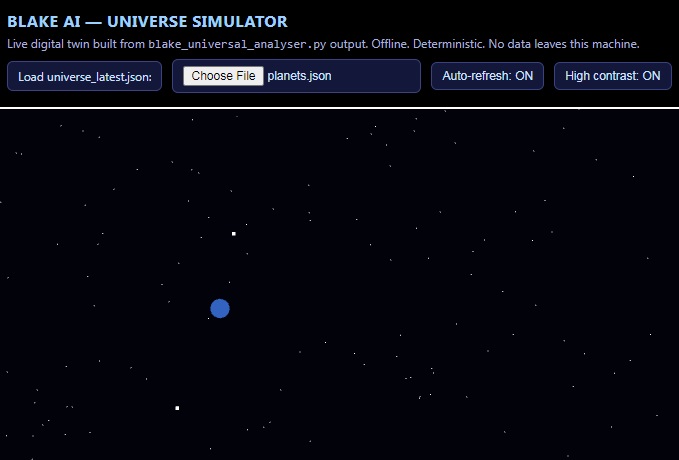
The Universe Viewer provides a dynamic environment where the unified model can be explored visually. Tissues appear as floating nodes, markers are represented as spatial elements, and physics signals form trails that can be followed through the scene. Audio characteristics and treatment outcomes are displayed as structured visual elements.
A Glimpse Into the Demo
This release offers a brief look at the simulator in action. It highlights the transition from raw inputs to a unified universe, and showcases the visual environment where the data comes to life. The teaser is intentionally concise, focusing on the experience rather than the underlying mechanics.
Built for Sovereignty and Transparency
The Offline Universe Simulator reflects a commitment to building AI systems that are transparent, explainable, and fully under the user’s control. By removing the need for cloud infrastructure and external data sources, the system ensures that all computation remains local and private. This approach supports a future where individuals and organisations can rely on AI without compromising autonomy or confidentiality.
What Comes Next
This release is only the beginning. Several major developments are already planned for future versions of the simulator including early access opportunities for Founding Members of Blake AI, join the waitlist here to get exclusive early access when it is released https://www.blake-ai.com/products/members/
These developments will continue to build on the core philosophy of deterministic, sovereign intelligence. The Blake AI Offline Universe Simulator represents a significant step toward a new vision of AI - one that is transparent, grounded in physics, and fully under the user’s control. This release is the foundation for a broader ecosystem of deterministic tools and technologies that will continue to grow in capability and scope.
There is still much work ahead, but this milestone marks the beginning of an exciting new chapter. I look forward to sharing more as the journey continues.
Founder CEO Blake AI - Deterministic by Design.
contactus@blake-ai.com